
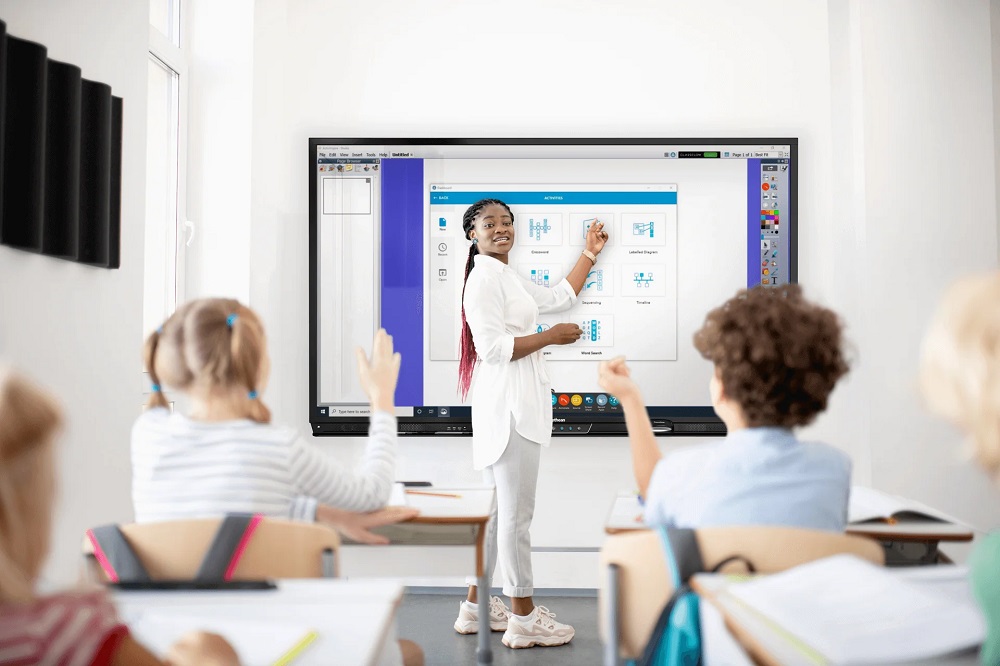
The traditional layout of a classroom has remained largely unchanged for generations. Rows of wooden desks facing a chalkboard, a teacher delivering a lecture from the front of the room, and students passively taking notes in silence formed the standard educational framework. While this model succeeded in standardizing education during the industrial era, it often fails to meet the needs of today’s hyper-connected, media-literate students.
A profound evolution is occurring within educational institutions globally. Classrooms are shifting from spaces of passive consumption to hubs of active collaboration. The interactive classroom, which integrates collaborative teaching philosophies, advanced digital tools, and flexible physical spaces, is rapidly becoming the new standard. By shifting the focus from the teacher to the learner, this modern approach fundamentally changes how students process information, retain knowledge, and develop critical workforce skills.
Moving Beyond Passive Listening to Active Engagement
The primary limitation of a conventional lecture-based environment is its reliance on passive listening. Research in cognitive science demonstrates that human attention spans are limited, and passive absorption leads to rapid information decay. Interactive classrooms address this issue by incorporating active learning strategies directly into the daily curriculum.
In an active learning environment, students do not just listen to concepts; they manipulate data, solve real-world problems, and discuss ideas in real time. For instance, rather than memorizing a list of chemical reactions from a textbook, students might use an interactive digital simulation to combine virtual elements, observing the results safely on a tablet screen. This immediate hands-on experience transforms abstract formulas into concrete visual realities, causing the brain to forge stronger neural connections and leading to much higher long-term retention of the material.
Maximizing Knowledge Retention Through Collaborative Learning
Human beings are naturally social learners. Interactive classrooms actively exploit this trait by structuring lessons around peer collaboration and group problem-solving.
Modern educational facilities accomplish this by redesigning the physical layout of the room. Heavy, forward-facing desks are replaced with lightweight, modular furniture on wheels. Within minutes, an instructor can transition a room from a standard testing configuration into small group clusters.
This physical agility supports a variety of impactful collaborative practices:
-
Peer-Led Instruction: Students who grasp a concept quickly explain it to their struggling peers, which deepens the understanding of both parties.
-
Structured Group Challenges: Teams work together to solve complex, open-ended problems, forcing them to negotiate, share perspectives, and synthesize different viewpoints.
-
Live Digital Brainstorming: Group members utilize shared digital whiteboards to map out project timelines, brainstorm essays, or compile research sources simultaneously.
-
Interactive Socratic Seminars: Software-enabled polling allows students to submit anonymous opinions on complex literary or historical topics, forming the basis for respectful, data-driven class debates.
Personalizing Education Through Real-Time Assessment Data
Every student learns at a unique pace. In a traditional lecture hall, a teacher might present a concept, assign homework, and discover a week later during a formal test that half the class misunderstood the core lesson. This delayed feedback loop creates severe learning gaps that become progressively harder to close as the semester advances.
Interactive classrooms solve this diagnostic delay through the use of formative assessment technology. Throughout a short lesson, an instructor can deploy quick, gamified quizzes or comprehension checkpoints to student devices. The aggregate results appear instantly on the teacher’s dashboard, providing a clear snapshot of class comprehension.
If the data reveals that a significant portion of the class is confused about a specific mathematical theorem, the teacher can halt the lesson immediately, pivot their strategy, and address the misconception on the spot. Conversely, if the data shows the students have mastered the material, the class can bypass redundant practice and move on to advanced topics, ensuring that educational time is always optimized.
Developing Crucial Soft Skills for the Modern Workforce
The modern global economy places a premium on cognitive flexibility, emotional intelligence, and communication skills. Technical knowledge alone is no longer a guarantee of professional success. Interactive classrooms serve as incubators for these essential soft skills, preparing students for the realities of the modern workplace long before they graduate.
When students spend their academic careers working in diverse, fluid teams, they learn how to communicate complex ideas clearly, listen empathetically to opposing arguments, and resolve interpersonal conflicts constructively. They discover that complex problems rarely have a single right answer and that collaboration frequently yields superior results compared to working in complete isolation. Furthermore, using modern collaboration software, remote presentation tools, and digital project management interfaces directly mirrors the operational habits of corporate environments, smoothing the transition from school to career.
Cultivating Lasting Intrinsic Motivation and Decreasing Absenteeism
Academic boredom is a major contributor to student disengagement, underperformance, and chronic school absenteeism. When students feel like invisible spectators in their own education, their motivation plummets. Interactive classrooms combat this disengagement by infusing elements of gamification, choice, and individual autonomy into the learning process.
By allowing students to choose how they demonstrate mastery of a subject, whether through a traditional essay, a digital video presentation, a podcast episode, or a working physical model, educators tap into intrinsic motivation. The classroom changes from a place of mandatory compliance into a dynamic environment where curiosity is celebrated. Schools that invest in interactive designs and technologies routinely report significant drops in behavioral disruptions, higher daily attendance rates, and a measurable increase in overall student satisfaction scores.
FAQ
Does an interactive classroom require an expensive budget and high-tech digital devices to be effective?
No, true interactivity is a pedagogical philosophy rather than a technology requirement. While digital interactive displays and individual student tablets certainly enhance the experience, a highly interactive classroom can be built using affordable materials. Movable whiteboards, physical manipulatives, structured debate formats, and intentional group-work strategies can transform a classroom without requiring any digital devices at all.
How do introverted or socially anxious students handle the constant collaboration of an interactive classroom?
Thoughtful instructors design interactive classrooms with balanced structures to support all personality types. Interactivity does not mean continuous group shouting. It includes quiet, independent reflection periods, structured pair-and-share activities that feel less intimidating than speaking to a large group, and anonymous digital input tools that allow introverted students to contribute deep insights without public speaking anxiety.
Do interactive classrooms lead to more behavioral issues and chaotic room environments?
While an interactive classroom is noticeably louder and busier than a silent lecture hall, this noise represents productive engagement rather than chaotic misbehavior. Because students are actively working on structured, meaningful tasks, they are significantly less likely to engage in off-task disruptions. Teachers act as active facilitators, moving through the room to guide progress rather than policing static rows of desks.
How do interactive learning strategies impact standardized test performance?
Data shows that students taught via active, interactive methodologies consistently match or outperform their traditionally taught peers on standardized tests. Because interactive learning emphasizes deep conceptual understanding and critical thinking rather than rote memorization, students are far better equipped to apply their knowledge to unfamiliar, complex questions found on comprehensive examinations.
Is interactive learning effective for teaching highly technical subjects like advanced physics or calculus?
Interactive learning is exceptionally effective for abstract, highly technical subjects. Complex mathematical and scientific concepts are often difficult to conceptualize through text and talk alone. Using digital graphing tools, interactive geometry software, and collaborative peer-problem derivation sessions allows students to visualize variables, test hypotheses, and understand the core logic behind advanced formulas.
How can a teacher ensure that one dominant student does not do all the work in a collaborative group?
Educators prevent this by utilizing specific group accountability frameworks. Roles within a group can be clearly defined and rotated regularly, ensuring every student has a unique, measurable contribution to make. Additionally, grading structures can incorporate individual accountability components, peer evaluations, and private self-reflections alongside the overall group project score.
